

In Israel alone, there are 1,861,000 school pupils who finish their school day at lunch time and need a hot, nutritious and healthy meal. These children can be divided into three main categories: those whose parents are waiting for them at home with a prepared lunch; those who will heat their own food, cooked for them ahead of time; and those who will cook their own lunch.
The DELI-VERY service provides children with the meal they need every day, while relieving the burden placed on parents. Every day, DELI-VERY food trucks will wait outside school to provide a complete packed meal, ready to be heated based on the order placed by the children or their parents.

Work Process
Meeting with product developers
Understanding the idea and start working.
Market research and users
Research of the market environment and its players.
Understanding the different users.
Accuracy of requirements and general idea
Drawing research conclusions and building
wireframe to start working.
Work on the platform
Work on all selected parts.
1
2
3
4
Meeting with the developer
This project was born out of an understanding of the need for parents to provide their children with lunch in their absence.
This is a real need that many parents across Israel experience every day. Assuming parents cook meals for their children, they are busy preparing lunch, either the day before or following long-term planning for several days. Either way, parents will spend many hours planning the meal, buying the ingredients, and actually cooking it. There is also the added component of successfully meeting their child's will and taste.
The goal is to produce a platform that will, on the one hand, decrease parents' preoccupation with preparing food for their children and, on the other hand, provide children with the nutritious, hot, and delicious meals they need.

Market research and users
A research was conducted to produce a navigation system for the service provided, dividing it into two options: The first option is placing an order from a specific restaurant, whereas the second is placing an order on a platform that combines several restaurants.
In the user study, we interviewed parents and children who shared their points of view concerning their preoccupation with their lunch after school.
Specific restaurant
A Platform that combines
several restaurants
Insights
There are two users of the platform: parents and their children.
Parents pay for the service, while their children actually consume the service, so there is a concrete need to address both types of users and their needs.
Due to the wide price range available on existing platforms, there is some difficulty for parents and children in deciding what to order.
The use of cash is a significant problem due to parents' fear of children losing the money or wasting it not for the purpose for which it was given.
Diversity - Children want to diversify their meals so the platform must allow for this and present a wide range of options for meals.
Priority - Most children prefer their parents to order food for them.
Without cash - Parents prefer not to let their children spend cash by themselves.
Social action - Ordering food together empowers children.
Children want to order meals together with their friends.
Order the food
Sending QR code
Collecting the food order
Send a message to the parent that the food has been
collected
In user interviews, we understood and reinforced some important points that helped us build the system and strengthen the concept.
In order to create a simple ordering process, there is no price difference in the cost of the meals. Same cost for all meals.
Safe Service
Healthy Food
Nationwide Deployment
Fresh Food
Every Day
Wireframe
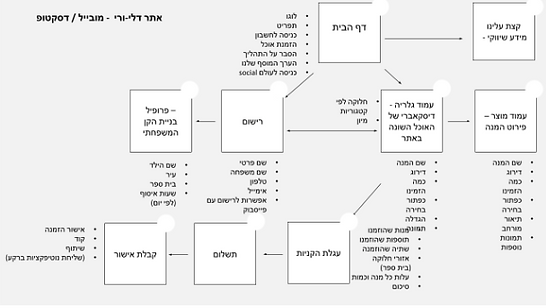
The development of the wireframe enabled the production of an orderly, clear and accurate system for the Service System. The system includes: registration to the system, building a user profile (family), menu page, etc. The navigation selected is similar to the navigation systems that the user is familiar with. The only exception are minor changes in the form of the order for a specific child.

Delivery App
The development of the wireframe enabled the production of an orderly, clear and accurate system for the Service System. The system includes: registration to the system, building a user profile (family), menu page, etc. The navigation selected is similar to the navigation systems that the user is familiar with. The only exception are minor changes in the form of the order for a specific child.
Delivery Website
The development of the wireframe enabled the production of an orderly, clear and accurate system for the Service System. The system includes: registration to the system, building a user profile (family), menu page, etc. The navigation selected is similar to the navigation systems that the user is familiar with. The only exception are minor changes in the form of the order for a specific child.

Explanation of The order schedule
As an integral part of the project development, a need arose to create an internal order management system that is updated in real time.
The system has been developed for Order Managers so that they can manage and find orders received. The system is a significant part of the Project Management Capability, and solves customers’ problems. The system has a daily dashboard line whose job is to provide a broad understanding of the day's activities in real time to the Order Managers.
Every order received is broken down into categories - customer name, order details, delivery time and service provider name, and more. In addition, each order has a status that is updated when switching between the various preparation stages. Order Managers can produce a selective filter for the various orders, thus finding a specific order that they are looking for.


Explanation of Dashboard
A significant part of the development of the service includes managing orders and analyzing them, which raises a need to create a dashboard screen. This screen allows connection amongst the various company departments, from Shipping to Marketing. The system enables analysis of all the domains that produce the complete service system. The dashboard screen has features from the different departments in a way that allows each department to share information with other departments. There is also a personal chat communication feature with other users of the dashboard screen in order to allow for efficient and quick communication.
*Dali-Very project was a group project that I worked on together with Gili Roland and Sharon Lapidot.